A Paper About Papers, or How to Read a Paper
I haven’t read many papers, probably because they seemed complex and I wasn’t sure how to approach them. Recently, I came across a paper that explains a three-pass approach to reading them.
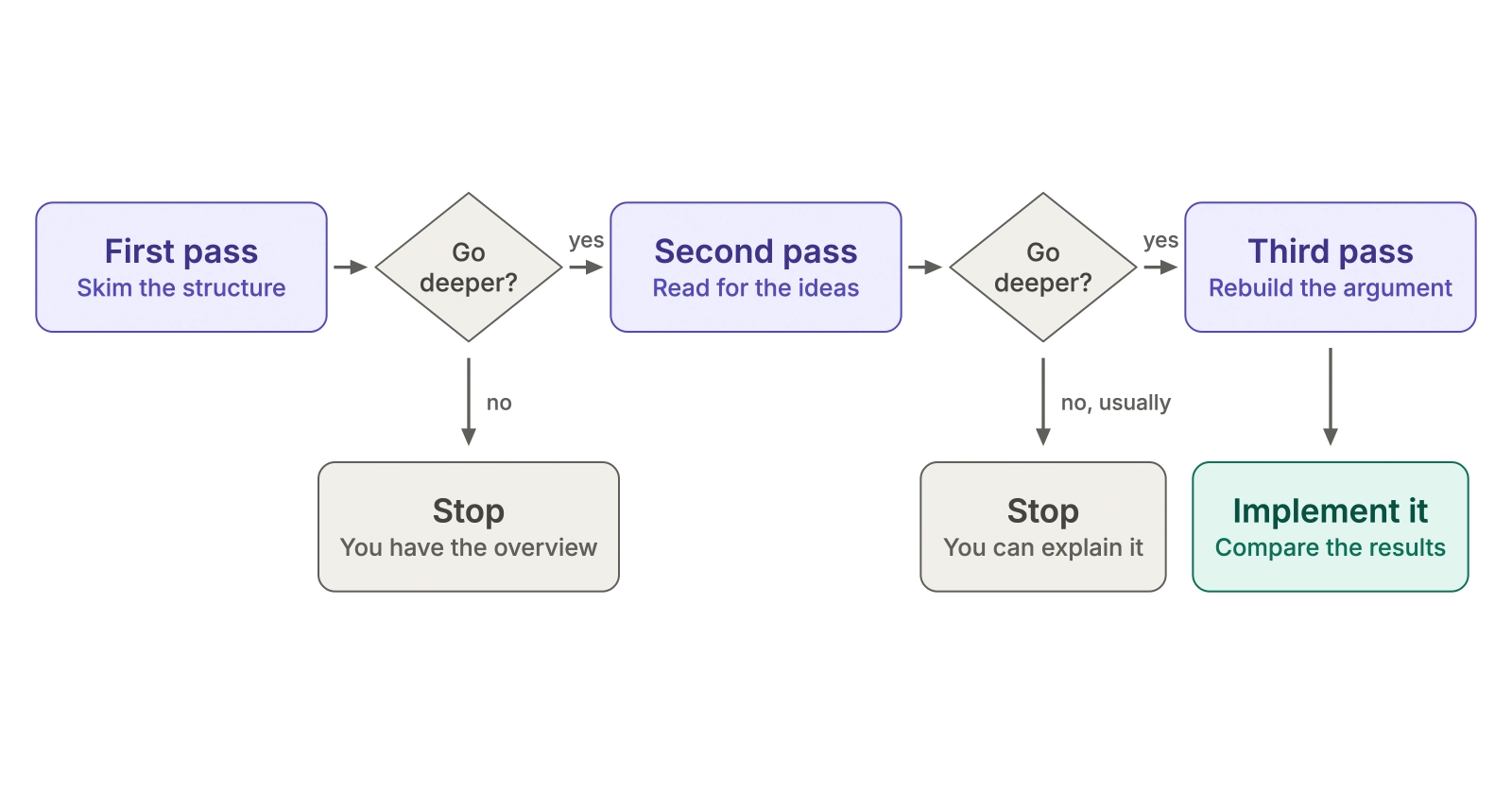
After each pass, decide how deep you want to go.
The first pass
This pass gives you a high-level overview of the paper.
- Read the title, abstract, and introduction.
- Read the section headings and subheadings, but skip the main text.
- Skim any formulas, graphs, or figures to get an idea of the background knowledge you’ll need.
- Read the conclusion.
- Check the references and note those you’ve already read.
After this pass, decide whether you want to continue.
The second pass
This pass helps you understand the paper’s main ideas.
- Read all sections, but skip the math proofs.
- Pay more attention to graphs, diagrams, and figures.
- Make notes as you go. Write down terms you don’t know and questions you want to explore later.
After this pass, you should be able to explain the paper’s main ideas and supporting arguments to someone else.
You might not understand everything, and that’s fine. If you need more background knowledge, set the paper aside and work through your notes and other prerequisites before coming back to it.
Then decide whether you want to go further. Usually you don’t. But if you want to understand the paper on a deeper level and build its argument yourself, go on to the third pass.
The third pass
This pass helps you understand the paper in depth.
- Read all proofs carefully.
- Question every assumption.
- Pay close attention to the details, such as the steps in a proof or how an algorithm’s performance is measured.
- Rebuild the argument yourself, using the same assumptions as the authors.
After this pass, you should understand the paper in depth and be able to identify its strong and weak points. You might also see ways to improve it.
My two cents
For software engineering papers, the third pass might be a great opportunity to also implement the method in code, run experiments, and compare your results with those reported in the paper.